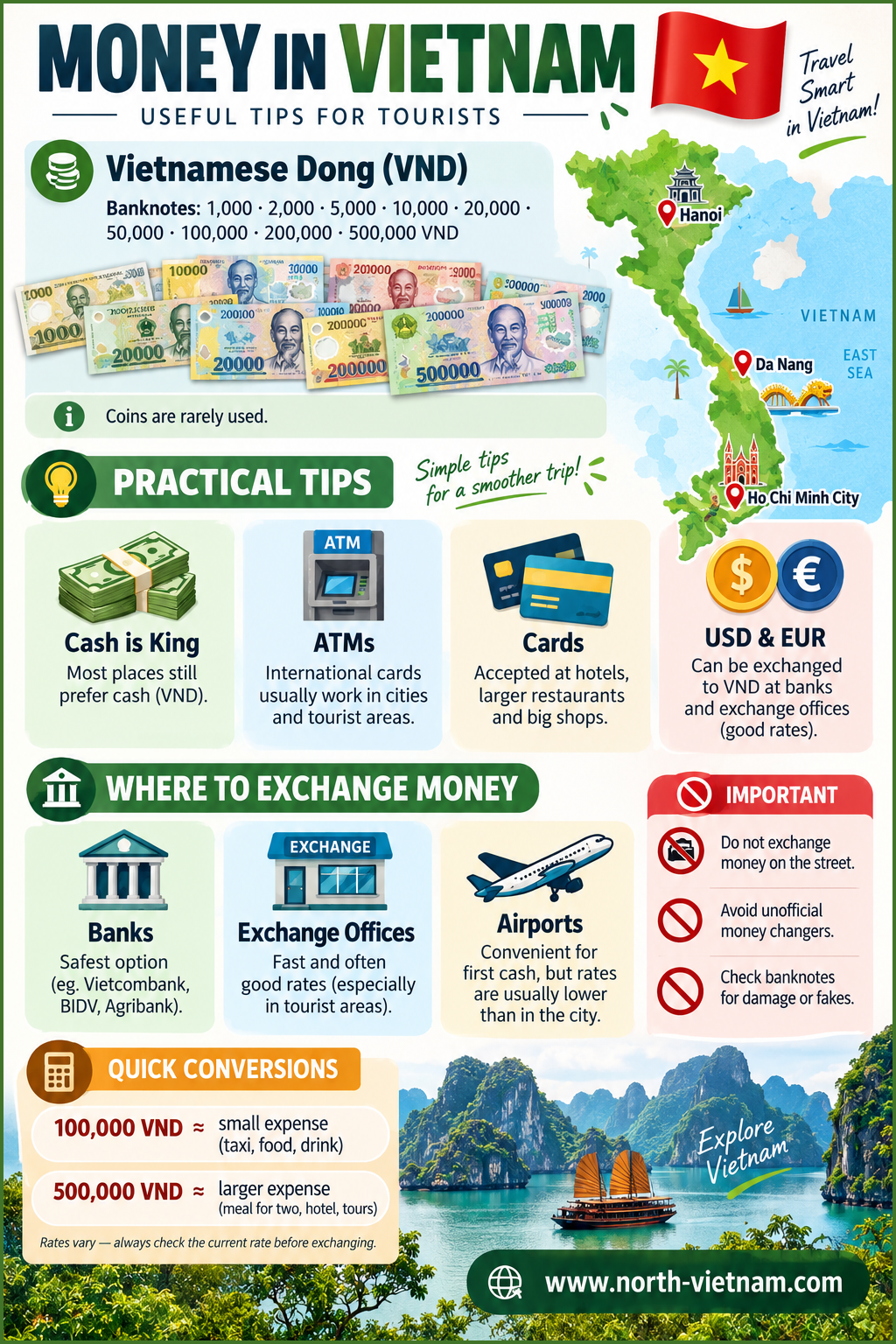
Vietnamese Dong (VND)
Local currency with large numbers and prices usually shown in thousands of dong
Cash is important
Most markets, local restaurants and smaller shops still prefer cash payments
Cards mainly in cities
Cards work in hotels and malls, but cash is still needed for daily spending
Check notes & fees
Some banknotes look similar and ATM or exchange fees can add extra costs
Quick answer: When travelling in Vietnam, the Vietnamese đồng (VND) is the official currency. Cash is king, especially for small purchases and in rural areas, but credit cards are increasingly accepted in cities and tourist spots. ATMs are widely available, and it’s best to carry some cash for convenience and to avoid fees.
At a glance:
- 💵 Currency: Vietnamese đồng (VND)
- 🏧 ATMs: Widely available in cities and towns
- 💳 Credit/Debit cards: Accepted in many urban shops, hotels, restaurants
- 💰 Cash usage: Essential for markets, street food, small vendors, and rural areas
- 📌 Currency exchange: Best rates found in banks or authorized exchange counters
For smooth travel, always have some cash on hand, especially in less touristy places.
Last updated in September 2026
💱 What is the official currency of Vietnam?
The official currency of Vietnam is the Vietnamese Dong (₫, VND).
The exchange rate is roughly around 1 USD ≈ 24,000–25,000 VND (recent average).
- ✔ currency: Vietnamese Dong (VND)
- ✔ approx. rate: 1 USD ≈ 24,000–25,000 VND
- ✔ cash is still widely used
- ✔ cards accepted in hotels, restaurants, and cities
💳 Payments in Vietnam
- cash (VND) is essential for small purchases
- credit and debit cards are accepted in larger places
- US Dollars may be accepted in tourist areas (not everywhere)
For everyday spending, it’s best to use Vietnamese Dong, especially in local markets, street food stalls, and smaller towns.
🏦 Currency exchange & ATMs
- use banks or official exchange offices
- ATMs are widely available in cities
- airport exchange is convenient but often less выгодný
You can easily withdraw local currency from ATMs or exchange money in major cities across Vietnam.
💵 Banknotes & denominations
- banknotes: 1,000 ₫ to 500,000 ₫
- most commonly used: 10,000 ₫ – 500,000 ₫
- coins are rarely used
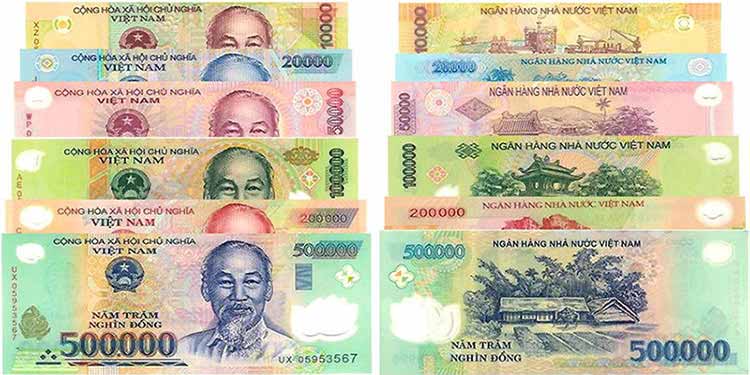
Learning to recognize different banknotes helps avoid confusion, as some notes look similar at first glance.
Always carry small cash for daily expenses and double-check banknotes when paying, especially in busy markets.
💸 Types of paper money in Vietnam (coins are not used):
200, 500, 1000, 2000, 5000, 10 000, 20 000, 50 000, 100 000, 200 000, 500 000.
Another option is to pay with US Dollars (this option is illegal officially). US Dollars are not also accepted at some retail outlets, small cities or villages. You can use them only in the big cities.
💱 Where to Exchange Money in Vietnam?
In Vietnam, you can exchange money at banks, currency exchange offices, hotels, or gold and jewelry shops. Tourists most commonly exchange US dollars (USD) or euros for Vietnamese dong (VND).
🏦 Banks
Banks are generally one of the safest options for exchanging money and often offer competitive exchange rates.
- Vietcombank
- BIDV
- VietinBank
- Agribank
💵 Currency Exchange Offices
Currency exchange offices are mainly found in tourist areas and city centers.
- often competitive exchange rates
- quick cash exchange
- be careful with unofficial exchange points
- check the banknotes you receive
🏨 Hotels
Some hotels offer currency exchange directly at the reception desk.
- convenient for tourists
- less favorable exchange rates
- suitable for smaller amounts
✈️ Airports
Currency exchange offices and ATMs are available at major airports in Vietnam.
- quick exchange after arrival
- usually less favorable exchange rates
- useful for getting your first cash
⚠️ What Should You Watch Out For?
Avoid unofficial street exchanges and suspicious offers.
- risk of counterfeit banknotes
- unfavorable exchange rates
- count your money immediately
Tip: Exchanging new and undamaged US dollars (USD) is often the most favorable option. ATMs are also widely available throughout Vietnam for withdrawing Vietnamese dong.
💵 Exchanging Money in Vietnam – What Applies from 2026
From 2026, new restrictions apply to regular licensed currency exchange offices in Vietnam. These exchange offices may only buy foreign currency – for example, you give them USD or EUR and receive Vietnamese dong (VND).
If you have Vietnamese dong left over at the end of your trip and want to exchange it back into USD or EUR before departure, such an exchange is reportedly permitted only at international airports or at border crossings within the departure area.
✅ Where Can You Exchange Money Safely and Legally?
- Banks: for example, Vietcombank, VietinBank, or Agribank. These are safe and legal options, although the exchange rate may not always be the best.
- Licensed currency exchange offices: look for clearly visible signs such as “Legal Currency Exchange Office” or “Đại lý thu đổi ngoại tệ”.
🏦 What are the banks in Vietnam?
Central bank of Vietnam is State bank of Vietnam. Almost every big city has several banks, and with exchange you should not have a problem. The most known banks in Vietnam are VietinBank, Vietcombank, Sacombank, Agribank, Eximbank. Opening hours are usually from 8 to 16 hours (there is a lunch break of about 1.5 hours), Saturday from 8 to 11:30.

| Banks in Vietnam | Website |
|---|---|
| Vietcombank | vietcombank.com.vn |
| BIDV | bidv.com.vn |
| Techcombank | techcombank.com.vn |
| VietinBank | vietinbank.vn |
| ACB | acb.com.vn |
| Sacombank | sacombank.com.vn |
| VPBank | vpbank.com.vn |
| TPBank | tpb.vn |
| MB | mbbank.com.vn |
| Agribank | agribank.com.vn |
🏦 Which foreign banks can you use in Vietnam?
Several international banks operate in Vietnam, mainly in larger cities such as Hanoi or Ho Chi Minh City. These banks offer services for travelers, expats, and businesses, including ATMs, bank accounts, credit cards, and international transfers.
🏦 HSBC
- operating in Vietnam since 1870
- one of the largest foreign banks
- personal and business banking
- credit cards and savings accounts
- branches in major cities
🏦 Standard Chartered
- operating since 1904
- well-established international bank
- personal loans and credit cards
- business and trade finance services
- branches mainly in large cities
🏦 Citibank
- operating in Vietnam since 1993
- branches in Hanoi and Ho Chi Minh City
- ATMs across the country
- personal and business banking
- international banking services
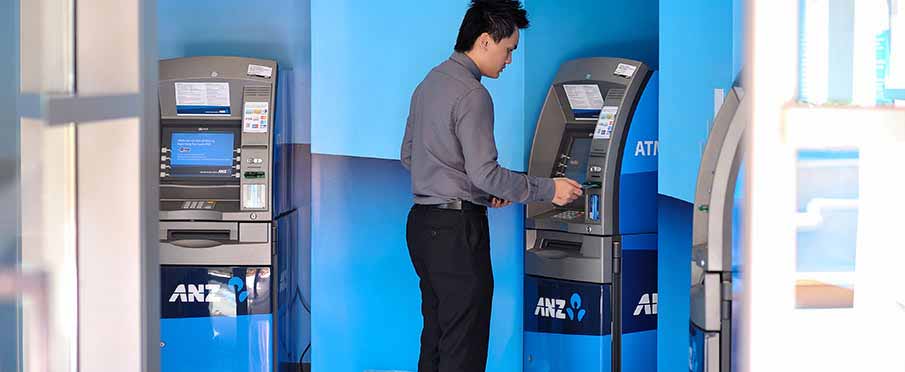
🏦 ANZ Bank
- operating since 1993
- popular foreign bank in Vietnam
- investment and wealth management
- personal and business banking
- services mainly in larger cities
Most foreign banks in Vietnam are concentrated in major cities and business districts. Travelers usually use them mainly for ATM withdrawals, currency exchange, or international banking services.

🏧 Cash dispensers, ATM and credit cards in Vietnam:
🏧 Cash, ATMs and cards in Vietnam – quick guide:
Vietnam has a modern banking system with widespread access to ATMs and card payments, especially in cities and tourist areas. Getting cash or paying by card is generally easy and convenient.
- 💵 ATMs: widely available in cities, accept international cards (Visa, Mastercard)
- 💳 Cards: accepted in hotels, restaurants, and larger shops
- 💰 Cash: still essential for small purchases and local markets
- 🌐 Accessibility: most ATMs offer English interface
- ⚠️ Tip: expect withdrawal fees and daily limits
For smooth travel, combine cash (VND) with a card and always keep some backup money.
Vietnam has a modern banking system, and ATMs are widely available in major cities, tourist areas, and many smaller towns. Most accept international debit and credit cards and offer English-language menus.
Credit and debit cards are widely accepted in hotels, restaurants, and larger shops. However, cash is still common at local markets, small businesses, and street food stalls, so it is useful to carry some Vietnamese Dong (VND).
Some places may accept US Dollars, but using Vietnamese Dong is usually more convenient. ATMs are an easy way to get cash, although withdrawal limits and transaction fees may apply.
💳 Which credit cards you can use in Vietnam?
💳 Credit cards in Vietnam – quick guide:
- ✔ accepted cards: Visa, Mastercard, American Express, JCB
- ✔ widely accepted in hotels, restaurants, and larger shops
- ✔ smaller businesses often prefer cash
- ✔ always carry some Vietnamese Dong (VND)
💸 Fees tip: Some banks charge foreign transaction fees (typically 1–3%) and ATM withdrawal fees.
When paying by card, choose to pay in local currency (VND) to avoid unfavorable exchange rates.
In Vietnam, major credit cards such as Visa, Mastercard, American Express, and JCB are widely accepted at hotels, restaurants, and larger shops. Smaller businesses, local markets, and street vendors may accept cash only, so it is worth checking before paying by card.
Some Vietnamese banks also issue local credit cards, mainly for residents, which may offer local benefits but have more limited international acceptance.
When traveling in Vietnam, it is best to carry multiple payment options, including cash and an international credit or debit card.
Is it possible to use ATM in the airports in Vietnam?
🏧 ATMs at airports in Vietnam:
- ✔ available at major airports (Hanoi, Ho Chi Minh City, Da Nang)
- ✔ accept international cards (Visa, Mastercard, AmEx)
- ✔ withdrawals in Vietnamese Dong (sometimes USD)
ATMs are easy to find inside airport terminals, but they can be busy.
It’s a good idea to have a backup payment option or withdraw cash later in the city.
Yes, you can use ATMs at major airports in Vietnam. ATMs are available inside the terminals at airports such as Tan Son Nhat in Ho Chi Minh City, Noi Bai in Hanoi, and Da Nang International Airport.
Most airport ATMs accept international cards such as Visa and Mastercard. Some machines may also offer cash withdrawals in US Dollars, depending on the bank and ATM.
Airport ATMs can be busy during peak periods, so it is useful to have some cash or another payment method available as a backup.
Is it possible to exchange your money in the airport in Vietnam?
💱 Currency exchange at airports in Vietnam:
- ✔ exchange counters available at major airports
- ✔ open 24/7 in most terminals
- ✔ possible to exchange foreign currency to VND
Airport exchange is convenient after arrival, but rates are usually worse than in the city.
Compare rates if possible or withdraw cash from an ATM as an alternative.
💡 Tip: Exchange a small amount at the airport and use banks or exchange offices in the city for better rates.
Yes, you can exchange money at major airports in Vietnam. Currency exchange counters are available in the terminals and can be used to exchange foreign currency for Vietnamese Dong (VND) or vice versa.
Exchange rates can vary between different counters, so it is worth comparing them before exchanging a larger amount. Some airports also have ATMs where you can withdraw Vietnamese Dong using an international debit or credit card.
For better exchange rates, you may prefer to exchange most of your money at a bank or licensed exchange office in town. However, airport exchange counters are a convenient option if you need cash immediately after arrival.
What are the ATM fees and withdrawal limits?
🏦 Vietcombank
ATM fee: ~30,000–55,000 VND
Withdrawal limit: usually 3–5 million VND
🏦 Agribank
ATM fee: ~22,000–55,000 VND
Withdrawal limit: around 3 million VND
🏦 BIDV
ATM fee: may be percentage-based (up to 3–5%)
Withdrawal limit: around 2–3 million VND
🏦 VPBank
ATM fee: often free for foreign cards
Withdrawal limit: up to 10 million VND
🏦 TPBank
ATM fee: approx. 3.3% fee (can vary)
Withdrawal limit: around 5 million VND
🏦 Sacombank
ATM fee: ~30,000–50,000 VND
Withdrawal limit: varies by ATM
Good to know: ATM fees and limits in Vietnam change frequently and may differ by card type or ATM location. In tourist areas, fees are often higher. VPBank is currently one of the best options for foreign cards due to lower or no withdrawal fees. Always choose payment in Vietnamese Dong (VND) and avoid dynamic currency conversion (DCC).
Before departing to Vietnam, announce your intention of traveling to your bank!
Your bank may block your credit card!

⚠️ What to watch out in Vietnam when exchanging your money:
⚠️ Quick advice for exchanging currency in Vietnam:
Use trusted banks or official exchange offices, especially in larger cities and tourist areas.
Always double-check the final amount you receive and avoid changing money with unofficial sellers on the street.
Exchange conditions and rates may differ from place to place, so it is worth checking several options before making a transaction.
When exchanging money in Vietnam, it is important to pay attention to exchange rates, hidden fees, and possible scams. In tourist areas, airports, or small exchange booths, rates may vary significantly.
💵 Compare exchange rates
- rates may differ between exchange offices
- compare multiple places before exchanging
- avoid offers that seem too good
- banks usually offer safer exchange
⚠️ Watch for hidden fees
- some places charge commissions
- service fees may reduce your amount
- always ask about final rates
- check how much you will receive
🧮 Count your money carefully
- always count cash before leaving
- check large banknotes carefully
- mistakes and scams can happen
- keep the exchange receipt if possible
🏦 Use trusted exchange places
- avoid unofficial street exchangers
- banks are usually the safest option
- hotels may offer worse rates
- large shopping centers are often reliable
For larger amounts of money, reputable banks or official exchange offices are usually the safest option. ATMs are also widely available throughout Vietnam, especially in larger cities and tourist destinations.
❓ Frequently Asked Questions – Money in Vietnam:
What is the official currency of Vietnam?
The official currency is the Vietnamese Dong (VND). The most common banknotes range from 1,000 ₫ to 500,000 ₫.
Can you use US dollars in Vietnam?
Some tourist places may accept US dollars, but Vietnamese Dong (VND) is the standard and preferred currency across Vietnam.
Where to exchange money in Vietnam?
You can exchange money at banks, exchange offices, airports, and some hotels; banks usually offer the best rates.
Is it better to exchange money in Vietnam?
Yes, exchange rates in Vietnam are often better than abroad, but it’s useful to arrive with a small amount of local cash.
Are credit cards accepted in Vietnam?
Visa and Mastercard are widely accepted in cities, hotels, and larger restaurants, but cash is still essential in local markets and rural areas.
Do ATMs in Vietnam accept foreign cards?
Yes, most ATMs accept international cards, although withdrawal fees and limits may vary by bank.
Can you use traveler’s checks in Vietnam?
Traveler’s checks are rarely accepted in Vietnam, so cash and debit or credit cards are better options.
How much money do you need for Vietnam?
Budget travelers spend about $20–30 per day, mid-range travelers around $50–80, while luxury travel usually starts above $100 daily.
Is tipping common in Vietnam?
Tipping is optional in Vietnam, but in tourist areas a tip of 5–10% is appreciated for good service.
Can you take Vietnamese Dong out of Vietnam?
Yes, but exchanging Vietnamese Dong outside Vietnam can be difficult, so it’s best to exchange unused cash before departure.
💰 Money in Vietnam – Quick Summary
Vietnam is still a relatively affordable country for most travelers. Cash (Vietnamese Dong – VND) is essential for markets, street food, local transport, and smaller shops, while cards are commonly accepted in hotels, malls, and tourist areas. ATMs are widely available across the country, but withdrawal fees and limits may vary by bank.
✔️ Good to know
- Vietnamese Dong (VND) is the official currency
- Cash is still very important
- ATMs are common in cities and tourist areas
- Visa and Mastercard work in many places
- Exchange money only at trusted places
⚠️ Watch out for
- Similar-looking banknotes
- ATM withdrawal fees and limits
- Worse exchange rates at airports
- Cash-only payments in rural areas
- Dynamic currency conversion (DCC)